
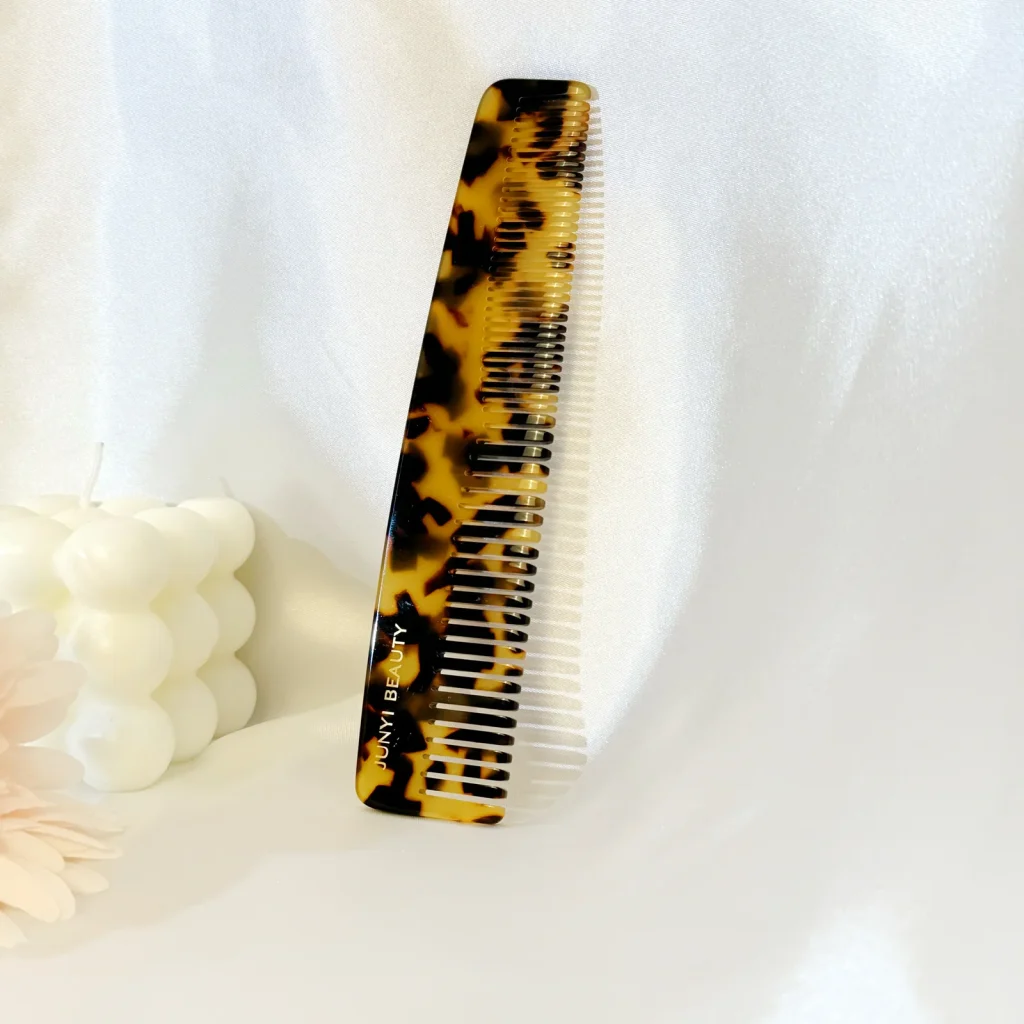
Considering cellulose acetate vs wood comb options for your collection? Neither material wins every category. Acetate offers a broad range of colors, translucency and patterned effects. Wood offers species-specific grain and a different visual character. In both cases, the quality of the teeth, the finish and the final geometry deserve at least as much attention as the material name.
If you are developing a comb collection, compare finished samples for the same task. A thick wide-tooth wooden comb and a thin fine-tooth acetate comb are not a useful material test. Too many design differences are being changed at once.
What to compare before choosing a material
| Decision | Cellulose acetate comb | Wood comb |
|---|---|---|
| Appearance | Colors, translucency and patterned material references | Species, grain and finish define the appearance |
| Variation between pieces | Agree pattern variation and visible-face expectations | Agree grain, color and finish variation |
| Tooth design | Assess material, machining and edge finish together | Assess species, grain orientation and tooth geometry together |
| Branding | Review contrast, position and the chosen method on the sample | Review method and legibility on the actual wood and finish |
| Care instructions | Confirm for the selected formulation and finished product | Confirm for the selected species, construction and finish |
| Claims | Require evidence for performance and environmental statements | Natural origin alone does not establish performance or environmental impact |
Appearance: deliberate patterns or natural grain
Cellulose acetate can support a strong color-led design: clear tones, pearl effects, solid colors and tortoiseshell-style patterns. Those choices can be coordinated with other accessories in a collection, although matching still requires physical approval.
Wood brings grain, color variation and the character of the selected species. A buyer should identify the species and finish rather than specify only “wood.” Two wooden samples can differ because of the species, the grain orientation or the coating, even if their outlines are identical.
Neither material guarantees identical-looking pieces. Irregular acetate patterns vary across the material; wood grain varies between pieces. If consistency matters, agree which variations are acceptable and keep representative samples. An unusually attractive sample is not a reliable description of the whole production run.
Geometry: compare the same type of comb
Tooth length, spacing, thickness and the transition into the spine affect the design in either material.
With wood, the grain direction and the slenderness of the teeth need consideration. With acetate, the selected material, tooth geometry and processing route need to be assessed together. “Natural” does not guarantee strength, and “plastic” does not guarantee flexibility.
If the design has a thin handle, a narrow gap or a sharp internal transition, ask how that feature will be made and inspected. Avoid importing dimensions from an unrelated comb simply because it uses the preferred material.
A fair sample comparison holds the key variables steady: similar overall size, similar tooth spacing and the same intended use. It then records differences in appearance, handling and finish without treating a small trial as proof of every possible performance claim.
Surface finish: look past the face of the comb
A carefully finished face is easy to photograph. The surfaces between the teeth are less obvious and often more important during use.
Check the tooth tips, the sides, the roots of the gaps and the handle perimeter. On a wooden comb, review the condition of the grain and the finish in those areas. On an acetate comb, look for remaining machining marks or edges that differ from the approved sample.
A coating changes the surface of a wooden product. Polishing changes the finish of an acetate product. Neither operation should be used as a substitute for getting the underlying geometry right.
If a supplier offers several finishing options, review actual examples. “Matte,” “satin” and “gloss” are not sufficiently precise specifications on their own.
Moisture and care: avoid the waterproof shortcut
Wood is hygroscopic: it gains or loses moisture as its surroundings change. That can lead to dimensional movement, and the extent depends on the wood and the conditions. Finishing and care affect exposure, but a wooden comb should not be assumed to behave identically in every bathroom or climate.
Cellulose acetate is not an excuse to ignore care either. Its formulation and the finished product still matter. Do not describe a particular comb as suitable for boiling water, dishwashing or prolonged soaking without evidence for those conditions.
For a brand, the useful outcome is a care instruction that matches the product. If the intended customers will clean the comb frequently, provide that use case at the sample stage. Ask what has been assessed and what should be avoided. A vague “easy to clean” claim is less useful than clear, realistic instructions.
Which direction fits the collection?
Acetate is worth exploring when color, translucency or a distinctive pattern is central to the design. Wood may be the better aesthetic direction when the collection is built around visible grain and the character of a particular species.
Cost cannot be ranked from the material name alone. Geometry, finish, quantity, inspection and packaging affect the quote. A simple design in either material can have a different cost structure from an intricate one in the same material.
The same caution applies to environmental positioning. “Plant-derived” and “wooden” are descriptions, not complete life-cycle assessments. Do not turn them into automatic claims of compostability, lower emissions or a particular disposal route.
What to ask before approving either sample
Ask for the material identity, the final dimensions, the tooth details, the finish, the expected variation and the care instructions. Confirm whether the sample uses the material and processing route proposed for production. If it does not, state what still needs to be demonstrated.
For an acetate design, start with the material guide and compare our acetate comb design references. We manufacture acetate products; wood is included here to help you compare materials.
If acetate fits your design direction, send the product brief. A useful brief explains why you are choosing it and which details you need the finished sample to resolve.
Further reading: The Wood Database: Wood and Moisture explains the general relationship between wood and humidity. Mazzucchelli 1849 provides cellulose acetate formulation background. Neither source is a comparative comb test.